
Welcome !


Varun's Blog - At the Speed of Light !

A fact is a simple statement that everyone believes. It is innocent, unless found guilty. A hypothesis is a novel suggestion that no one wants to believe. It is guilty, until found effective. ~Edward Teller

A very warm welcome to my th reader.Why speed of light ? Well, the aim of this blog is to reach the impossible by exploration and scientific fervor. Exploration never ends, knowledge never dies but Speed of Light can be achieved ....

Subscribe now

Tuesday, April 11, 2006

NASA spacecraft hits moon - a search for water


NASA today announced that a small spacecraft, to be developed by a team at NASA Ames, has been selected to travel to the moon to look for precious water ice at the lunar south pole.


The name of the mission is LCROSS, short for Lunar CRater Observation and Sensing Satellite. LCROSS is a secondary payload: It will hitch a ride to the moon onboard the same rocket as the Lunar Reconnaissance Orbiter (LRO) satellite due to launch from the Kennedy Space Center in October 2008.


Left: LCROSS approaches the moon...
Daniel Andrews's team proposed LCROSS. He says , "We think we have assembled a very creative, highly innovative mission." LCROSS will hunt for water by hitting the moon--twice--throwing up plumes that may contain signs of H2O.

It works like this: After launch, the LCROSS spacecraft will arrive in the moon's vicinity independent of Lunar Reconnaissance Orbiter. On the way to the moon, the LCROSS spacecraft's two main parts, the Shepherding Spacecraft (S-S/C) and the Earth Departure Upper Stage (EDUS), will remain coupled. As the pair approach the moon's south pole, the upper stage will separate, and then hit a crater in the south pole area. A plume from the upper stage crash will develop as the Shepherding Spacecraft heads in toward the moon. The Shepherding Spacecraft will fly through the plume using its instruments to analyze the cloud for signs of water and other compounds. Additional space and Earth-based instruments also will study the 2.2-million-pound (1000-metric-ton) plume.
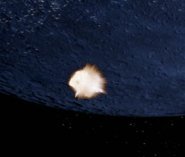

Left: ...and hits. Pictured is the first of two impacts delivered by the split craft.

Lunar Reconnaissance Orbiter and LCROSS are the first of many robotic missions NASA will conduct between 2008 and 2016 to study, map, and learn about the lunar surface to prepare for the return of astronauts to the moon. These early missions will help determine lunar landing sites and whether resources, such as oxygen, hydrogen, and metals, are available for use in NASA's long-term lunar exploration objectives.

NASA NEWS RELEASE

Read More...

Thursday, April 06, 2006

Planets around Dead Stars


NASA's Spitzer Space Telescope has uncovered new evidence that planets might rise up out of a dead star's ashes.

The infrared telescope surveyed the scene around a pulsar, the remnant of an exploded star, and found a surrounding disk made up of debris shot out during the star's death throes. The dusty rubble in this disk might ultimately stick together to form planets.

This is the first time scientists have detected planet-building materials around a star that died in a fiery blast.


Pic : An artist's concept of a planet-forming disk around pulsar 4U 0142+61. [Movie]

The paper on the Spitzer finding appears in the April 6 issue of Nature. Other authors of the paper are lead author Zhongxiang Wang and co-author David Kaplan, both of the Massachusetts Institute of Technology.

"We're amazed that the planet-formation process seems to be so universal," says Deepto Chakrabarty of the Massachusetts Institute of Technology, principal investigator of the new research. "Pulsars emit a tremendous amount of high energy radiation, yet within this harsh environment we have a disk that looks a lot like those around young stars where planets are being born."


The finding represents the missing piece in a puzzle that arose in 1992, when Aleksander Wolszczan of Pennsylvania State University found three planets circling a pulsar called PSR B1257+12. Those pulsar planets, two the size of Earth, were the first planets of any type ever discovered outside our solar system. Astronomers have since found indirect evidence the pulsar planets were born out of a dusty debris disk, but nobody had directly detected this kind of disk until now.

The pulsar observed by Spitzer, named 4U 0142+61, is 13,000 light-years away in the constellation Cassiopeia. It was once a large, bright star with a mass between 10 and 20 times that of our sun. The star probably survived for about 10 million years, until it collapsed under its own weight about 100,000 years ago and blasted apart in a supernova explosion.

Some of the debris, or "fallback," from that explosion eventually settled into a disk orbiting the shrunken remains of the star, or pulsar. Spitzer was able to spot the warm glow of the dusty disk with its heat-seeking infrared "eyes." The disk orbits at a distance of about 1 million miles and probably contains about 10 Earth-masses of material.

see captionPulsars are a class of supernova remnants, called neutron stars, which are incredibly dense. They have masses about 1.4 times that of the sun squeezed into bodies only 10 miles wide. One teaspoon of a neutron star would weigh about 2 billion tons. Pulsar 4U 0142+61 is an X-ray pulsar, meaning that it spins and pulses with X-ray radiation.

Any planets around the stars that gave rise to pulsars would have been incinerated when the stars blew up. The pulsar disk discovered by Spitzer might represent the first step in the formation of a new, more exotic type of planetary system, similar to the one found by Wolszczan in 1992.

"I find it very exciting to see direct evidence that the debris around a pulsar is capable of forming itself into a disk. This might be the beginning of a second generation of planets," Wolszczan says.

Read More...

Tuesday, March 21, 2006

Solar Eclipse 29 March 2006


ECLIPSE VIEWING SAFETY!

A Solar Eclipse is a truly, truly wonderful phenomena. But one
MUST OBSERVE IT CAREFULLY!

SEVERE eye damage can result if the sun is viewed improperly at any time!!

Safe Methods of Viewing

METHOD 1) Eclipse Glasses

This is the most affordable method. Eclipse glasses are very inexpensive and can be found many places. Just be sure to buy them well before the eclipse, because they will be very hard to come by a day or two before. Make sure that the glasses have the "CE" certification on them.

Eclipse glasses usually consist of a cardboard frame holding two pieces of filtering material where the glass would be in normal sunglasses. The filters remove 99.99% of the Sun's visible light and 100% of the harmful UV. There are now two types of eclipse glasses. The older type has filters made of aluminized Mylar. The newer type uses black polymer lenses. Both will give good protection, but the black polymer type is better all around. They show a more natural color and can be used to look at sunspots any time the Sun is visible. They are more expensive than the Mylar glasses, but well worth the price.

Always check the glasses carefully before each use for pinholes. If you find any, cut the glasses up with scissors and throw them away.

METHOD 2) Special Telescope Filters

These filters fit over the FRONT END of a telescope. Again, they filter out most of the Sun's light. The advantage with this method is that one can see a magnified image of the Sun, with sunspots, granulation, speckles, and other features. The disadvantage is that the filters are more expensive (plus one needs a telescope).

METHOD 3) Welder's Glass

Be careful that you use the right kind of glass! Welder's glass is numbered from 1 to 14 with 14 being the darkest. It is only number 14 glass that is dark enough for solar viewing! And NO STACKING! A pair of number 7's or a 10 and a 4 together DO NOT have the same protection as a single piece of number 14 (see unsafe methods for more details).

METHOD 4) Telescopic Projection

One can get a nice, large, bright image visible to several people at the same time. It requires no special equipment beyond the telescope itself and some sort of flat screen. HOWEVER: It can be VERY DANGEROUS unless one knows EXACTLY how to do it properly! Not only can it cause severe and permanent eye damage, but it can also easily set things on fire. USE CAUTION when following these instructions!


Unsafe Methods of Viewing

Keep in mind that this is by no means an exhaustive list. People have historically been very clever in coming up with stupid ways to observe the Sun. In general, when you're considering whether or not a particular method is SAFE, ask yourself these questions:
"Is this method I'm using SPECIFICALLY designed for solar viewing?"
"Do I know EXACTLY what I'm doing?"
If the answer to either of these questions is "no," then for your vision's sake, don't try it!

(a)Sunglasses (b)Multiple Sunglasses

(c)Mylar Balloons (d) Mylar Food Wrappers (Pop Tart Bags, etc.)

(e) Smoked Glass (f) X-Ray Film

(g) Film Negatives (h) CD's or CD-ROM's

(i) Stacked Welder's Glass

(j) Stacked Welder's Glass

(k) Liquid Filters

(l) Eyepiece Solar Filters

(m) Eclipse Glasses and Telescopes Together

Read More...

Thursday, March 16, 2006

MOONQUAKES ?


NASA astronauts may need quake-proof houses as they are going back to the moon.
The moon is seismically active.Between 1969 and 1972, Apollo astronauts placed seismometers at their landing sites around the moon,instruments faithfully radioed data back to Earth.

And what did they reveal?

There are at least four different kinds of moonquakes:
(1) deep moonquakes about 700 km below the surface, probably caused by tides;
(2) vibrations from the impact of meteorites;
(3) thermal quakes caused by the expansion of the frigid crust when first illuminated by the morning sun after two weeks of deep-freeze lunar night; and
(4) shallow moonquakes only 20 or 30 kilometers below the surface.

The first three were generally mild and harmless.Between 1972 and 1977, the Apollo seismic network saw twenty-eight of them; a few "registered up to 5.5 on the Richter scale". A magnitude 5 quake on Earth is energetic enough to move heavy furniture and crack plaster. Shallow moonquakes lasted more than 10 minutes. The moon rang like a bell.

On Earth, vibrations from quakes usually die away in only half a minute. The reason has to do with chemical weathering: "Water weakens stone, expanding the structure of different minerals. When energy propagates across such a compressible structure, it acts like a foam sponge—it deadens the vibrations." Even the biggest earthquakes stop shaking in less than 2 minutes.

The moon, however, is dry, cool and mostly rigid, like a chunk of stone or iron. So moonquakes set it vibrating like a tuning fork. Even if a moonquake isn't intense , it just keeps going and going.

"Any habitat would have to be built of materials that are somewhat flexible," so no air-leaking cracks would develop. "We'd also need to know the fatigue threshold of building materials," that is, how much repeated bending and shaking they could withstand.

What causes the shallow moonquakes? And where do they occur? The Apollo seismometers were all in one relatively small region on the front side of the moon, so we can't pinpoint [the exact locations of these quakes].
We're especially ignorant of the lunar poles. That's important, because one candidate location for a lunar base is on a permanently sunlit region on the rim of Shackleton Crater at the Moon's south pole.

Proposals for deploying a network of 10 to 12 seismometers around the entire moon is on, to gather data for at least three to five years. This kind of work is necessary, to find the safest spots for permanent lunar bases.
Other planets must be shaking too.We have to study the moon before establishing habitats on mars or beyond.

NASA NEWS RELEASE

Read More...

Saturday, March 11, 2006

Breaking News Headlines

I don't need to say anything but these images say it all.

Read More...

This is science !

When you are speaking to technically illiterate people you must resort to the plausible falsehood instead of the difficult truth.

Photos of Comet Mcnaught !
Astro-photographer? Send your photos to pics@exploreuniverse.com and have them featured on this blog with your name. Comet Mcnaught : Pictures taken with Nikon D100 on 19/1/07 from Manning Point, northern NSW, Australia by Mr. Peter Enright.
Picture 1
Picture 2
Picture 3
Picture 4

Space News

Astronomy Picture of the Day